 Back
Back
Published 2026.03.29
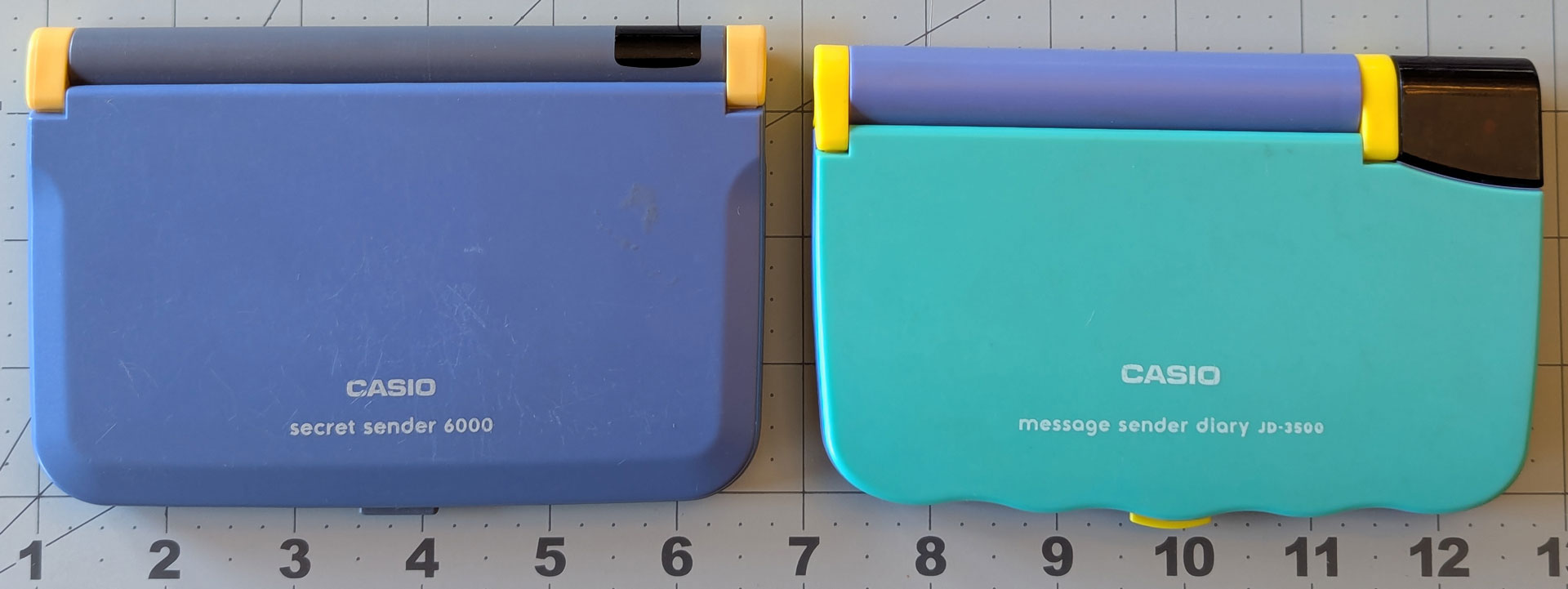
In the fast-paced world of 1990s business, one could easily become lost without the constant companion that was the PDA. These devices appeared one day as coveted tools of the modern workplace, quickly gained ubiquity, then vanished just as quickly as they arrived as technologies advanced and they became obsolete; but for a few short years, they were everywhere: calculating tips, converting currency, reminding people of appointments, and storing contacts. In a world of paper planners and rolodexes, they could be a businessman's best friend, but one company dared to ask the question: what if you made a personal organizer for kids? It was an untapped market. That was the bold vision that everyone's favorite oddball Japanese technology manufacturer, Casio, had in the early '90s.
On paper, it's a brilliant idea. Kids love scheduling appointments, right? And they need a place to store the contact information of their professional colleagues just like anyone else. And with the arrival of foreign exchange students on the playground, you never know when little Jimmy is going to need to convert some international currencies. But before booking that Saturday morning ad slot to get all the young'uns salivating over these productivity gadgets, they had to think of a special feature... some "killer app" to make the PDA appeal to the next generation of electronics consumers.
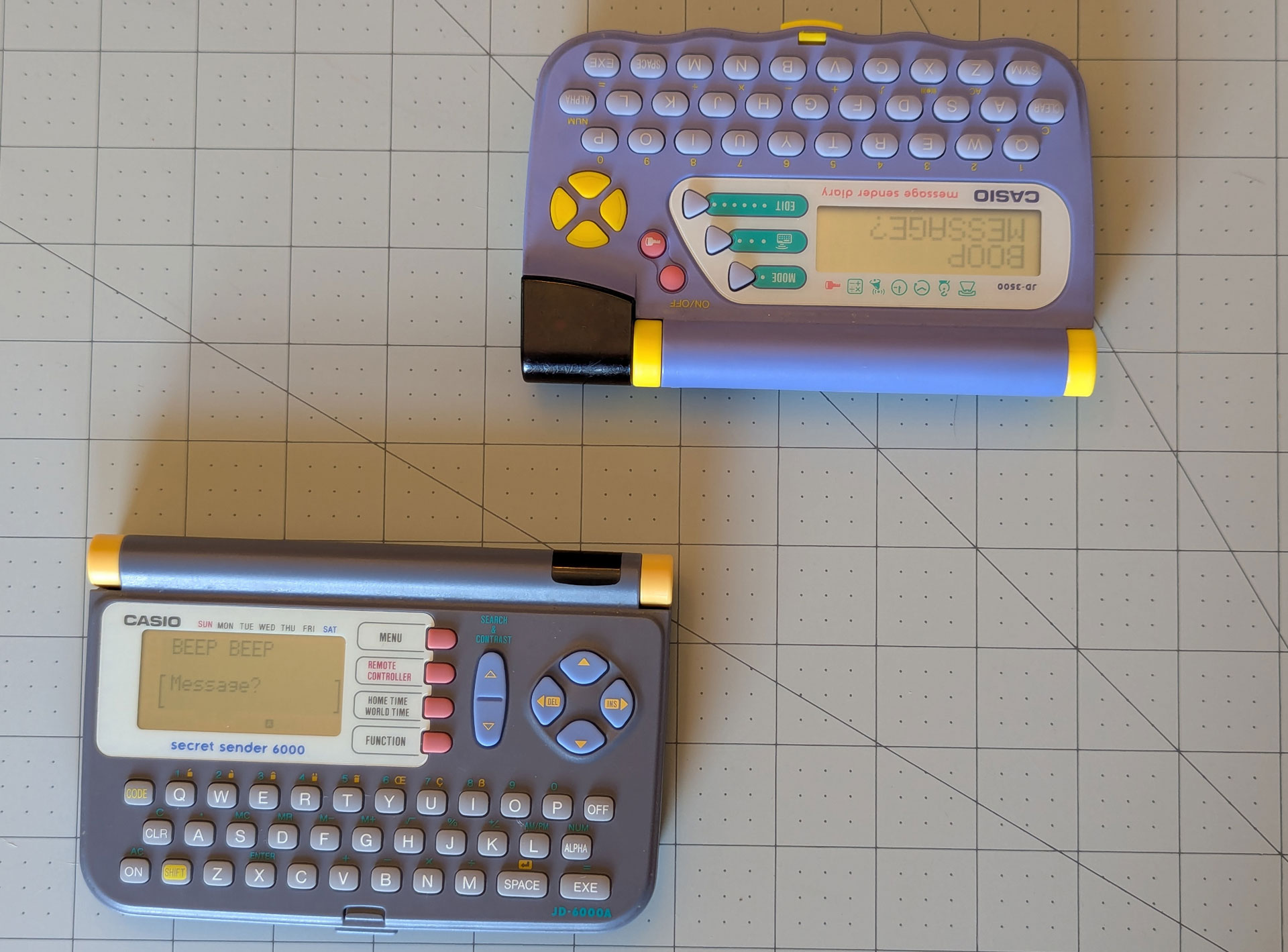
Before (and arguably after) the advent of cell phones, if there was one thing kids loved, it was sending messages back and forth from mere feet away, particularly in situations where talking is frowned upon such as at church or in the classroom. From passing paper notes to the Cybiko (distant cousin to today's topic whom I shan't mention further) to Pictochat on the Nintendo DS, the ability to send a short phrase of text some twenty feet was considered a rip-roaring good time by children the world over. From this noble concept was born the Casio Secret Sender line of children's PDAs.
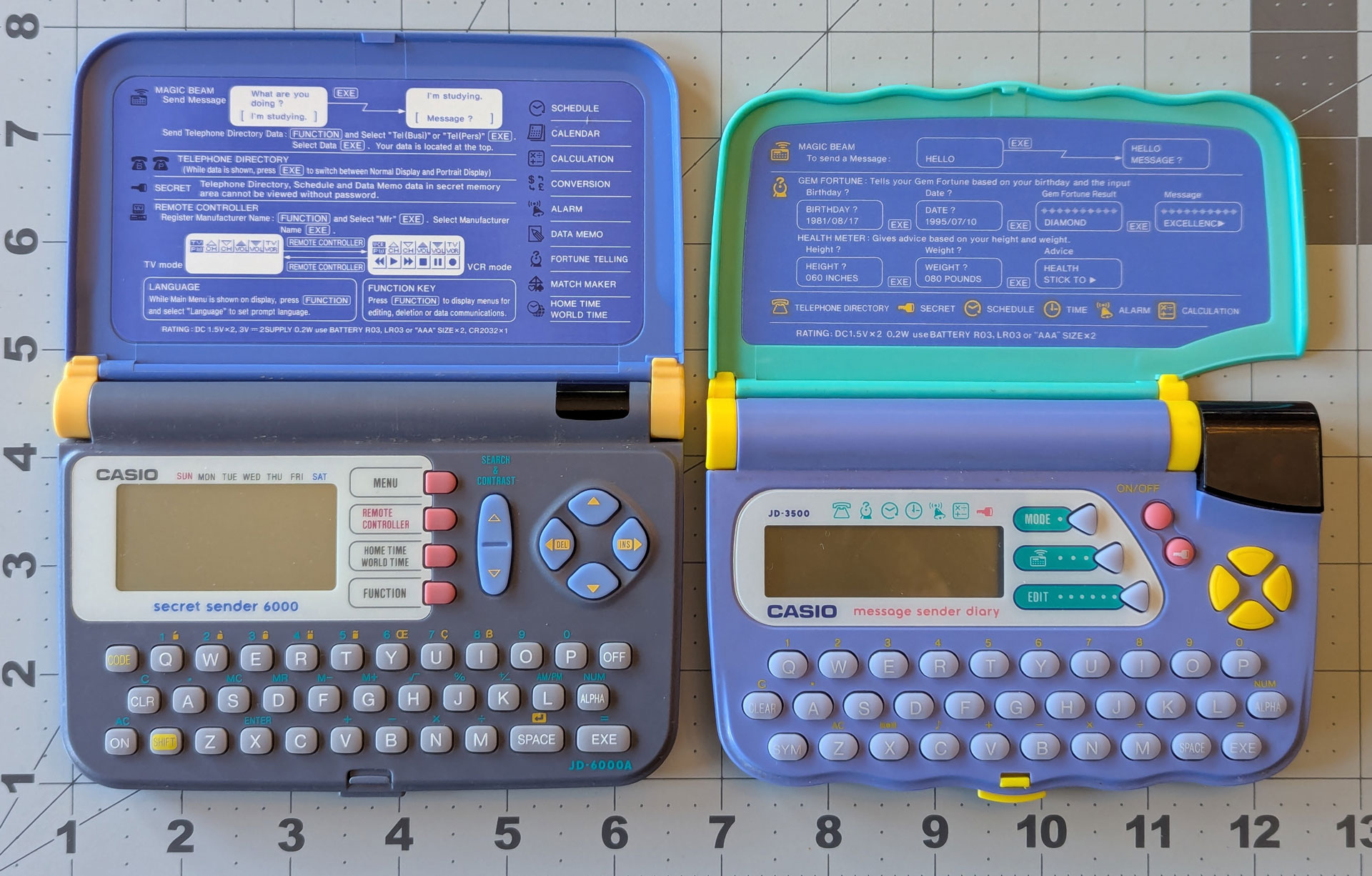
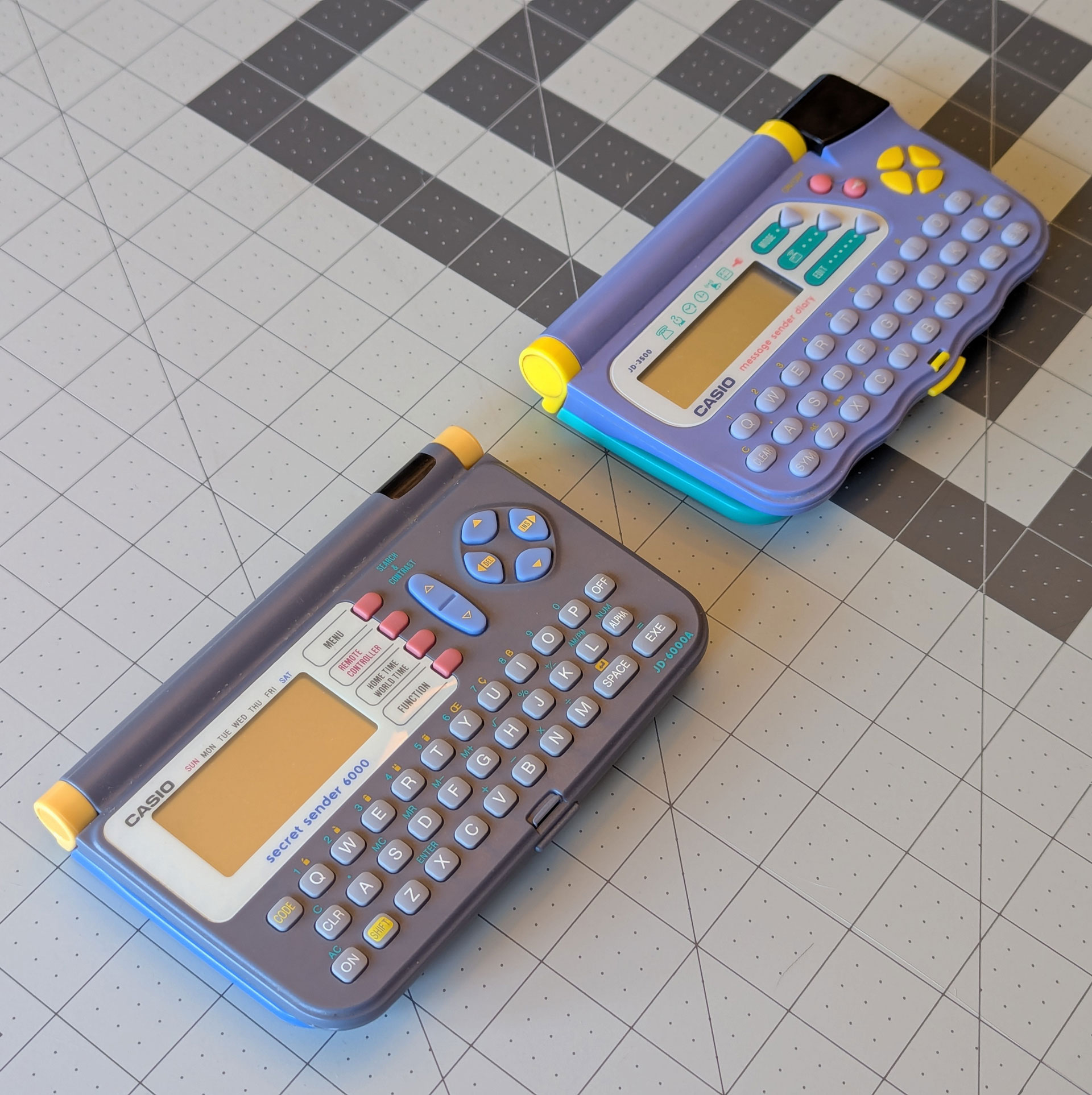
I purchased a lot comprised of two different models (two JD-6000s and a JD-3500) from the Secret Sender lineup last year as a part of my quest to accumulate obsolete junk to write about on this blog. Actually, I passed them off as Christmas gifts to myself, my wife, and my brother, so I can personally attest to how fun they are.
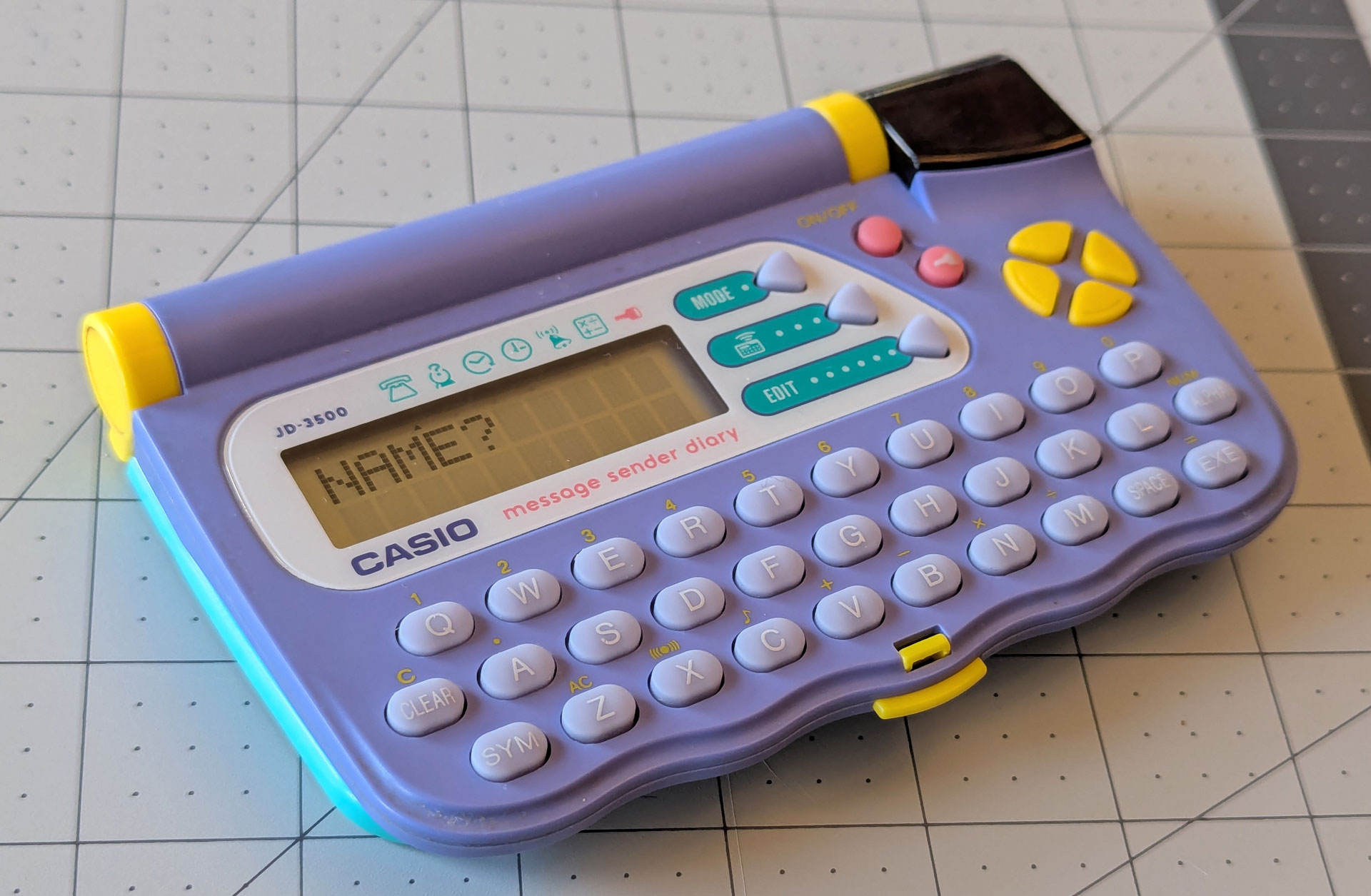
The verbosely named Casio Message Sender Diary JD-3500 is the more primitive of the two Secret Sender models. Overall, even as a toy, the 3500 is not great. The nicest thing that can be said about it is that its design is charming and is overall a lot cuter than the 6000 with its fun colors, wavy front edge, and asymmetric cutout in the lid for the infrared communicator. I appreciate the way the hinges on both the Secret Senders allow the lid to be flipped all the way around to get it out of the way while in use.
It features a diminutive LCD display with a mere two lines of ten characters. It has no backup battery, so any precious contacts or scheduled events that you store on it will be lost as soon as the batteries die (though it does appear to have the ability to retain the data for a short time without power if you change the batteries fast enough), and there is seemingly no way to back up its internal memory to be restored after changing the cells. The device has a miniscule memory capacity of roughly 2 kilobytes, which equates to some mix of around 80 telephone entries or 60 scheduled events. That's not much but given the limited usefulness and ephemerality of the data with no backup battery, I doubt many users even hit that limit. Its meager feature set allows users to perform basic calculation, store phone numbers, schedule events, store password-protected secret versions of that same data, view the time, set an alarm, get a "gem fortune" or health advice, and send very primitive messages over the infrared output on the device's rear.
The "gem fortune" takes the user's birthday and the current date as input, the latter of which is pre-populated, given the device does at least know what day it is—for all the limitations, the JD-3500 still has a perpetual calendar that accounts for leap years. From these two values it assigns you a gemstone, a score from 1 to 10 (displayed in little gem-shaped icons), and one of a very small number of fortune messages for the day. For instance, as of the day of writing, my fortune was 10 gems, diamond, "EXCELLENCE IS HERE." Other nuggets of wisdom from the mighty fortune program include "FUTURE IS ROSY", "PROBLEMS ARE AHEAD", and "BE CONFIDENT!". It doesn't detect if it's your birthday and play a song or anything—the dates are just inputs for pseudo-randomization.
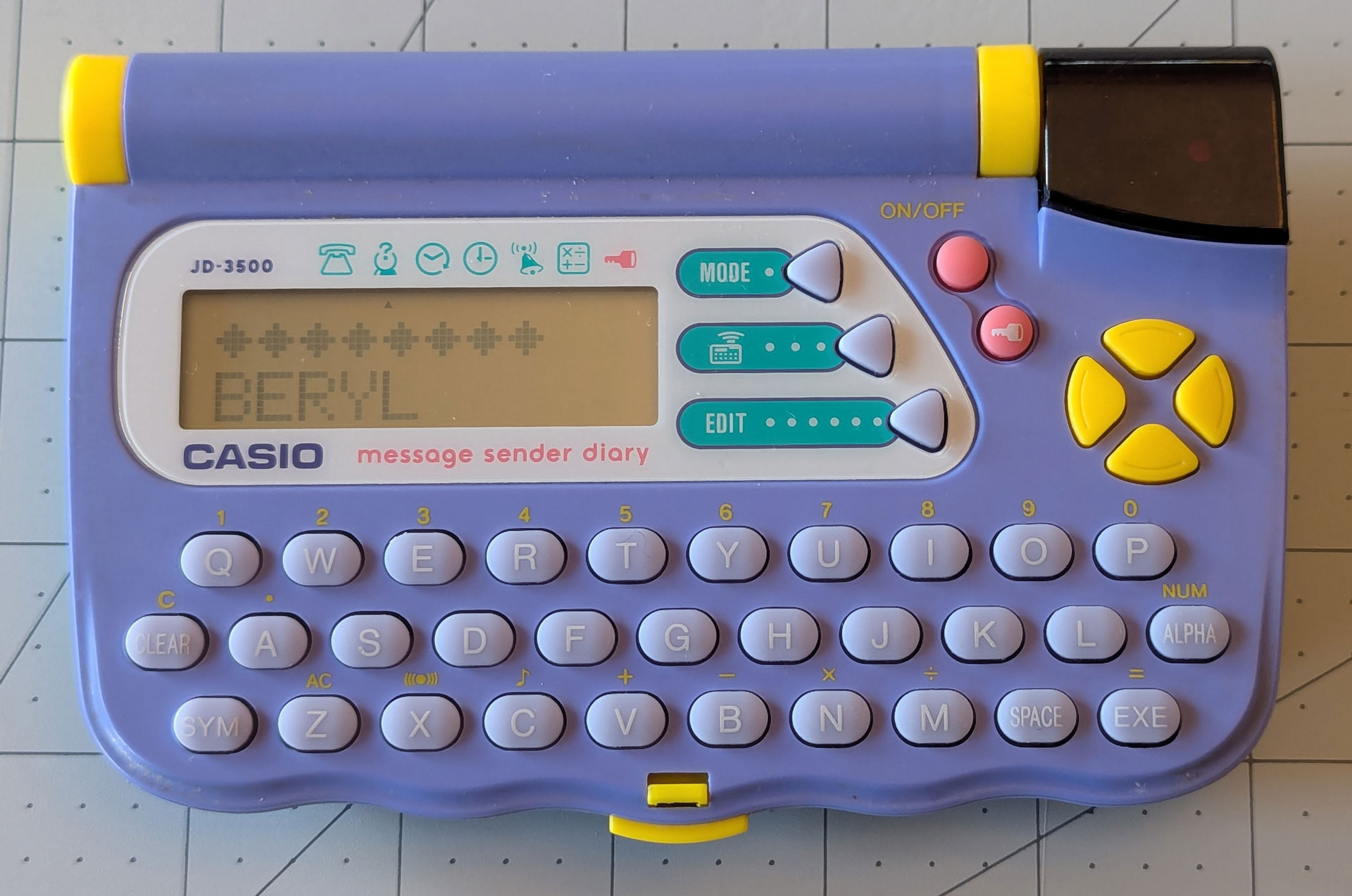
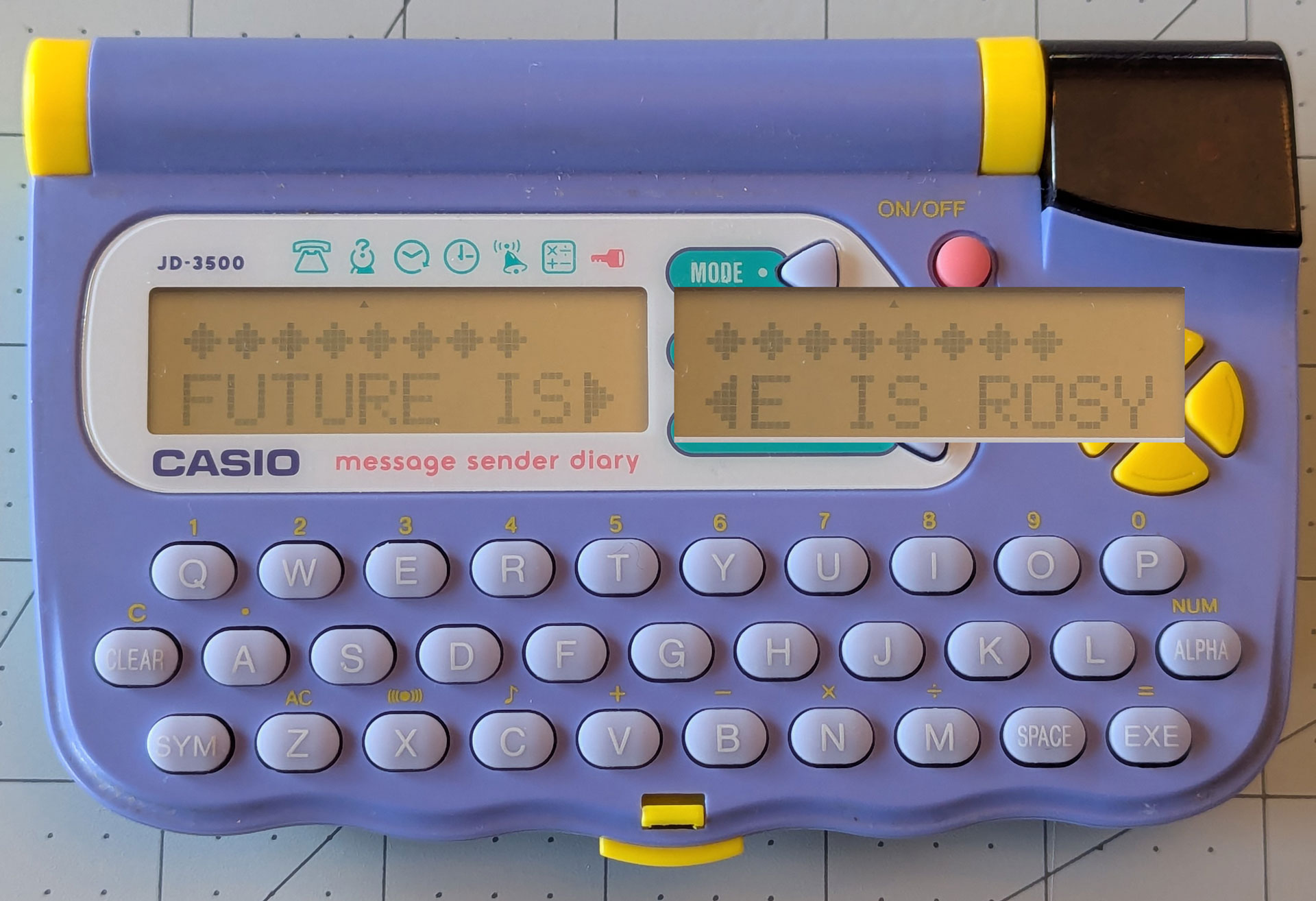
The screen is so tiny that you have to scroll to read the short fortune
The health advice is much the same, using your height in inches and weight as inputs instead to mete out such tips (with no real correlation to the input values) as "BREAKFAST IS THE KEY", "EAT SMART, LESS JUNK!", and "CARE FOR YOUR HEALTH". Even ludicrous combinations like 999 inches and 1 pound yield these nebulous suggestions. Wii Fit this ain't. For as uninteresting as that is, I have to admit that the random benign advice here is probably preferable to any system that actually involves giving children specific instructions based on their height and weight. Nevertheless, I'm not fond of this inclusion. Especially in a "diary" toy marketed at little girls, the implications for causing potential body image issues and disordered eating just make the whole idea seem ill-conceived.
While the organizational features may have been useful to some kids as a planner or travel alarm clock, I imagine most users grew bored with it pretty quickly. There are no games on it, nor anything else that could really even be construed as "fun" besides the fortune telling, which provides about a second of novelty per day and will begin repeating almost immediately. The only way I really see a kid getting sustained entertainment from the JD-3500 is through the infrared messaging, and even in that capacity the inferior PDA leaves something to be desired.
While technically compatible with the other Secret Senders, it lacks the ability to display, send, or receive lowercase characters. When using the 3500 with the 6000, for example, it will send messages just fine but can only receive messages from the 6000 if they contain all caps. That is to say, any lowercase letters contained in the sent messages will not be received; for example, if the user of the 6000 sends the message "Hello", the 3500 will display simply "H". This essentially gives rich kids with the more expensive Secret Sender a private channel on which to trash talk their less fortunate companions who got stuck with the 3500. To compensate for this, one can enable a caps lock mode on the 6000, but unless everyone in your friend group bought the budget model, the 3500 would be frustrating to use with friends and incredibly dull to use on your own.
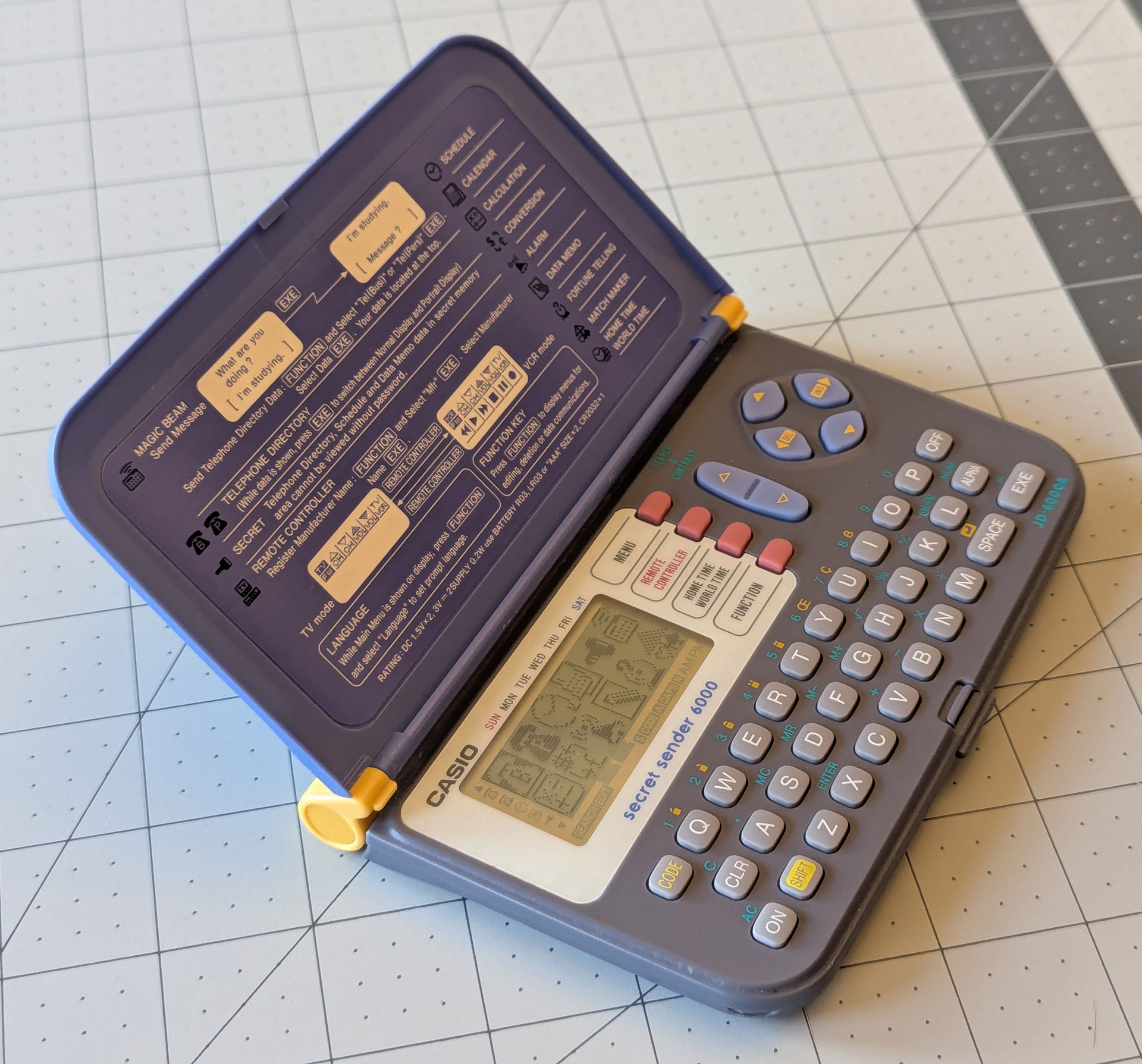
Unlike the JD-3500, the JD-6000 is a toy with solid potential to entertain a kid in the pre-smartphone era on an ongoing basis. I haven't spoken to anyone who actually used these as a child but from my impression as an adult, I have to say I think it would have been a winner. That's not to say it's perfect, but it provides numerous improvements to the JD-3500 while retaining most of the functionality of its weaker sibling. Only two sacrifices are made with respect to the 3500: firstly, the health advice is not present on this model; secondly, the design is quite a bit less fun. While the 3500 looks like a totally tubular toy that any kid would want to play with, the 6000 with its muted colors looks more like a calculator. On the plus side, this more serious design would make it more easy to sneak into the classroom, which was no doubt the use case most of its prospective owners had in mind.
Also unlike the 3500, the 6000 has a graphical monochrome LCD display, albeit a fairly low-resolution one. In addition to the modes present on the budget model (all of which offer significant improvements from their rudimentary forms on the other Secret Sender), the 6000 features a currency converter, data memo, world time, universal remote control for TVs and VCRs, and a "match maker" which alleges to predict the romantic compatibility of two people based on their birthdays.
The fortune functionality is much more robust on the JD-6000. It starts with a cute crystal ball image.
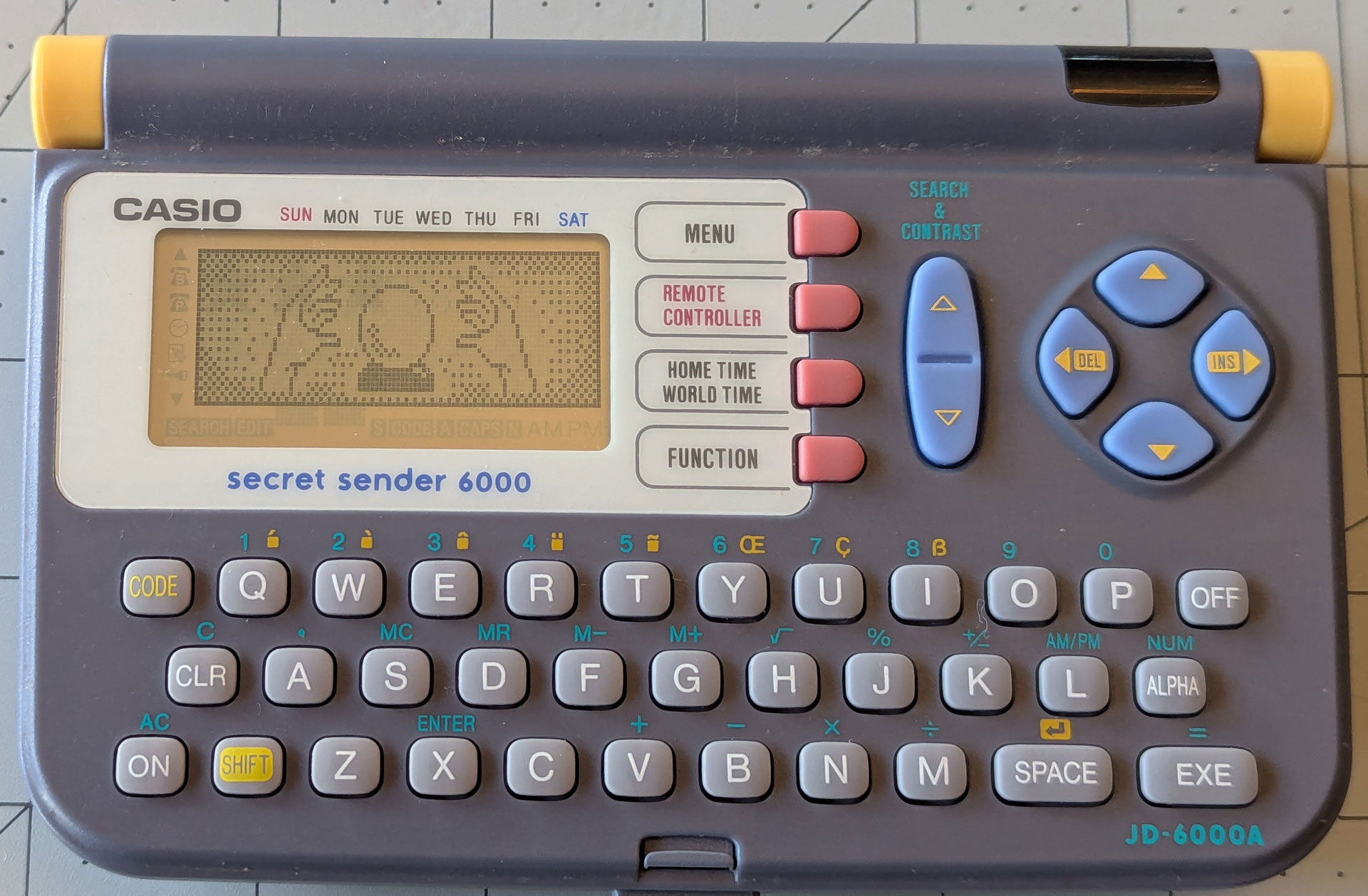
Then it provides you with one of a few fortunes. They're much longer and with more possibilities, the chances of a repeat are lower than on the 3500. Here are a few that I got:
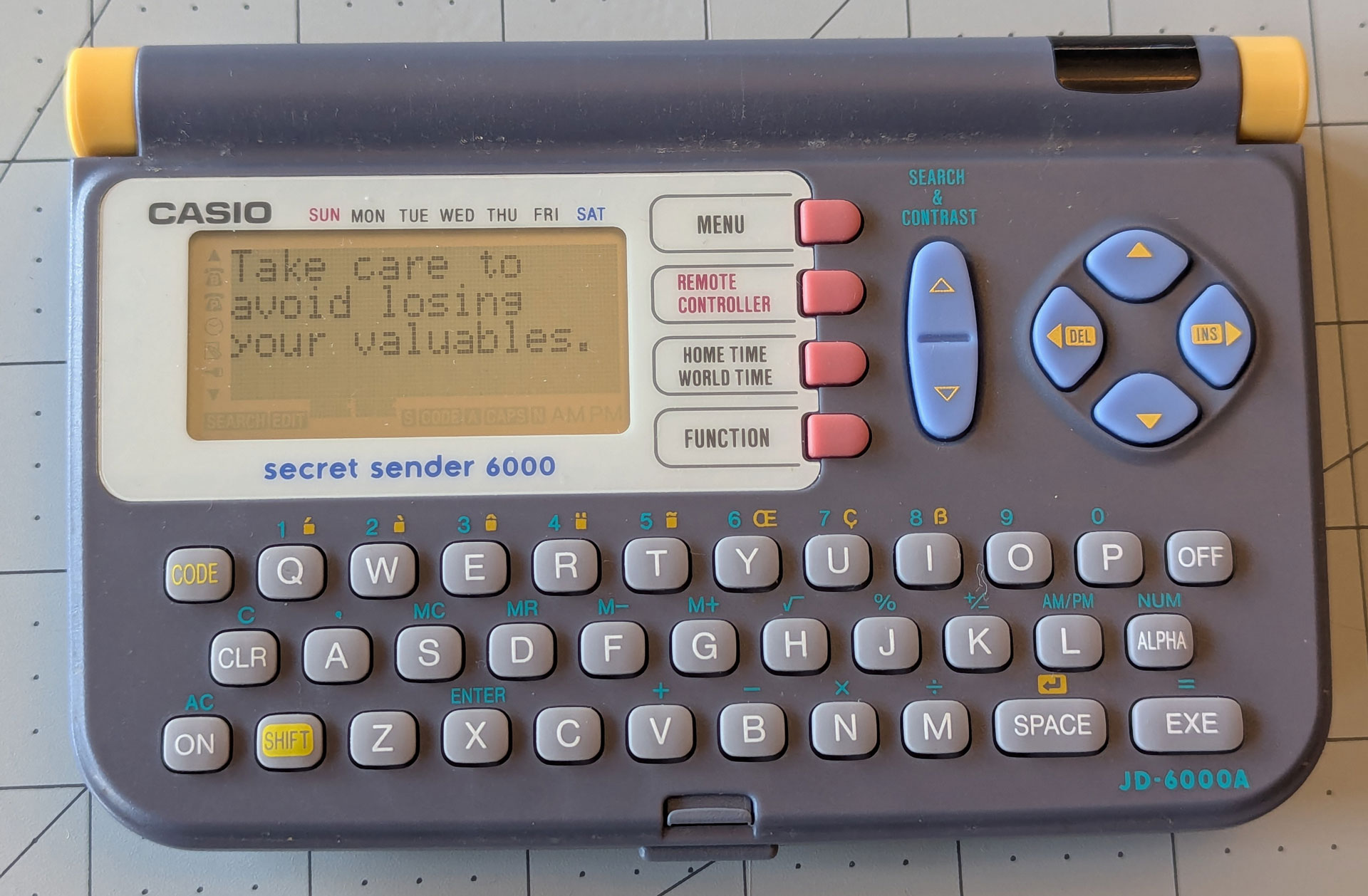
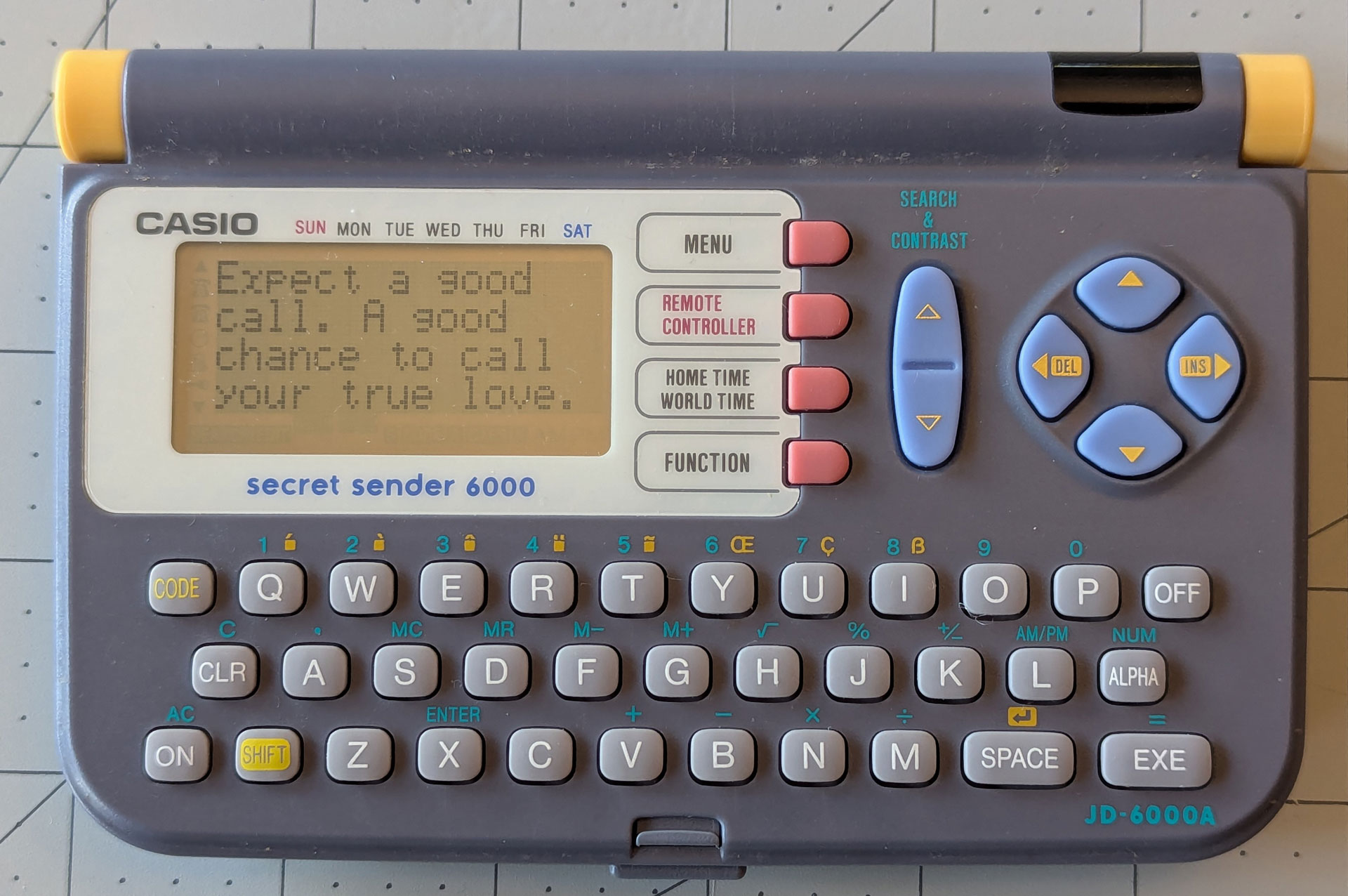
Second only to short-distance messaging, the ability to mess with televisions in public was considered a top-tier hijink among the rowdy youth of the era as Casio were doubtlessly aware; the original TV commercials for the JD-6000 featured hip '90s kids turning a boring trip to the library under the watchful eye of a dull, bossy adult into a super groovy dance party through the power of the Secret Sender. As an aside, you may note that the ads for this device refer to the line of kid's products as "Casio Cool". This branding seems to have been added after product development, since that moniker is not present on the devices themselves nor is it featured in their manuals.
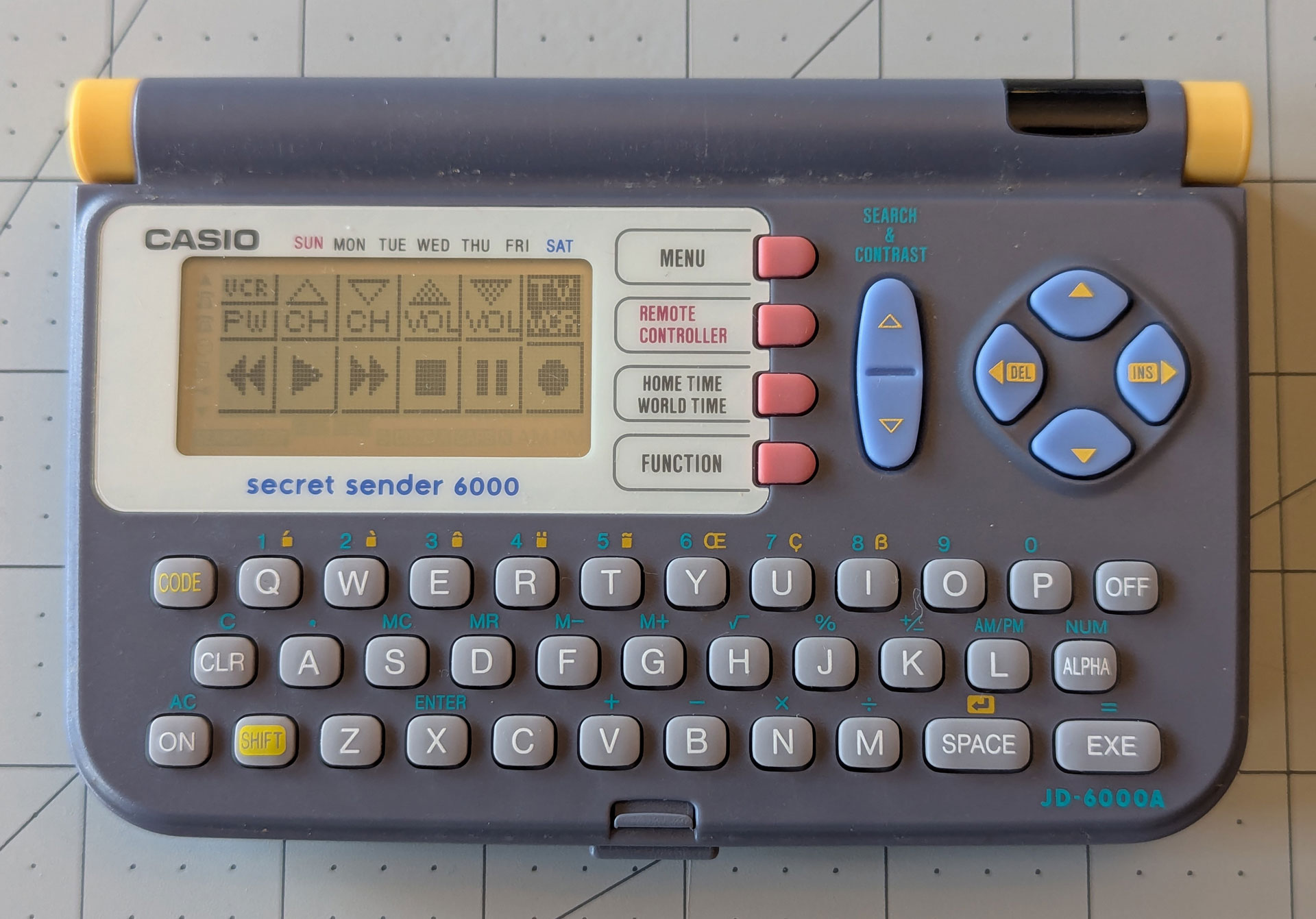
Unfortunately, the remote control feature isn't very well implemented. Instead of a programmable universal remote (like the Casio Wrist Remote Controller watches from around the same time), Casio chose to make the user pick a specific TV/VCR manufacturer from a list. Since remote codes can vary within the same company's product lines, this means you may have to test a few different options for a specific brand, and your device may not even be supported even if it's made by one of the listed companies. I tested the remote control with an old Sansui CRT TV (not one of the supported brands) as well as a modern TCL LCD TV and a Magnavox VCR (which is on the list of supported brands for TVs, but not for VCRs), and none of them worked. That exhausted my options for potential candidates to control. Suffice it to say, I wouldn't count on the ability to use this feature, but if you have a TV that happens to support it, it could be a nice feature.
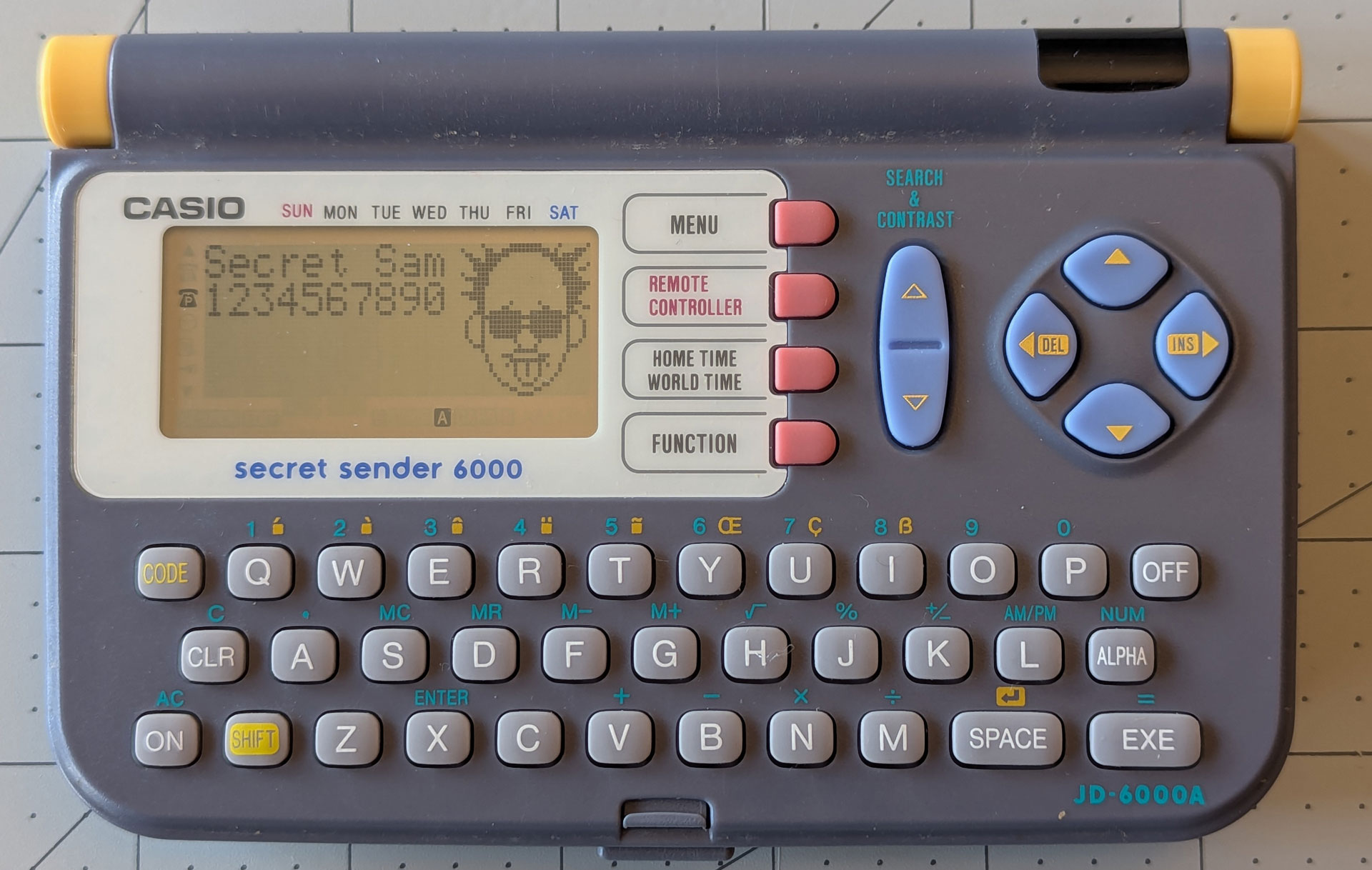
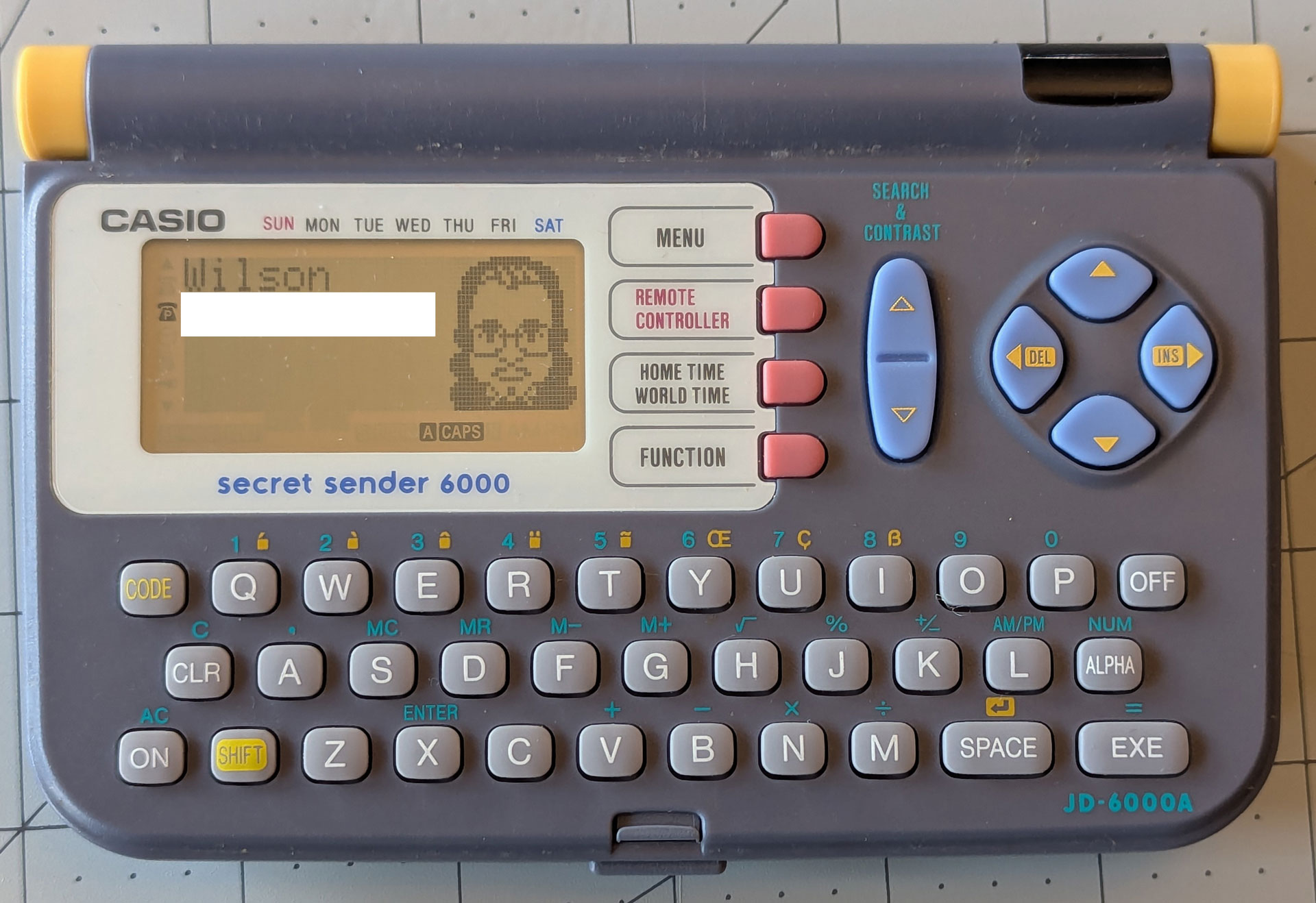
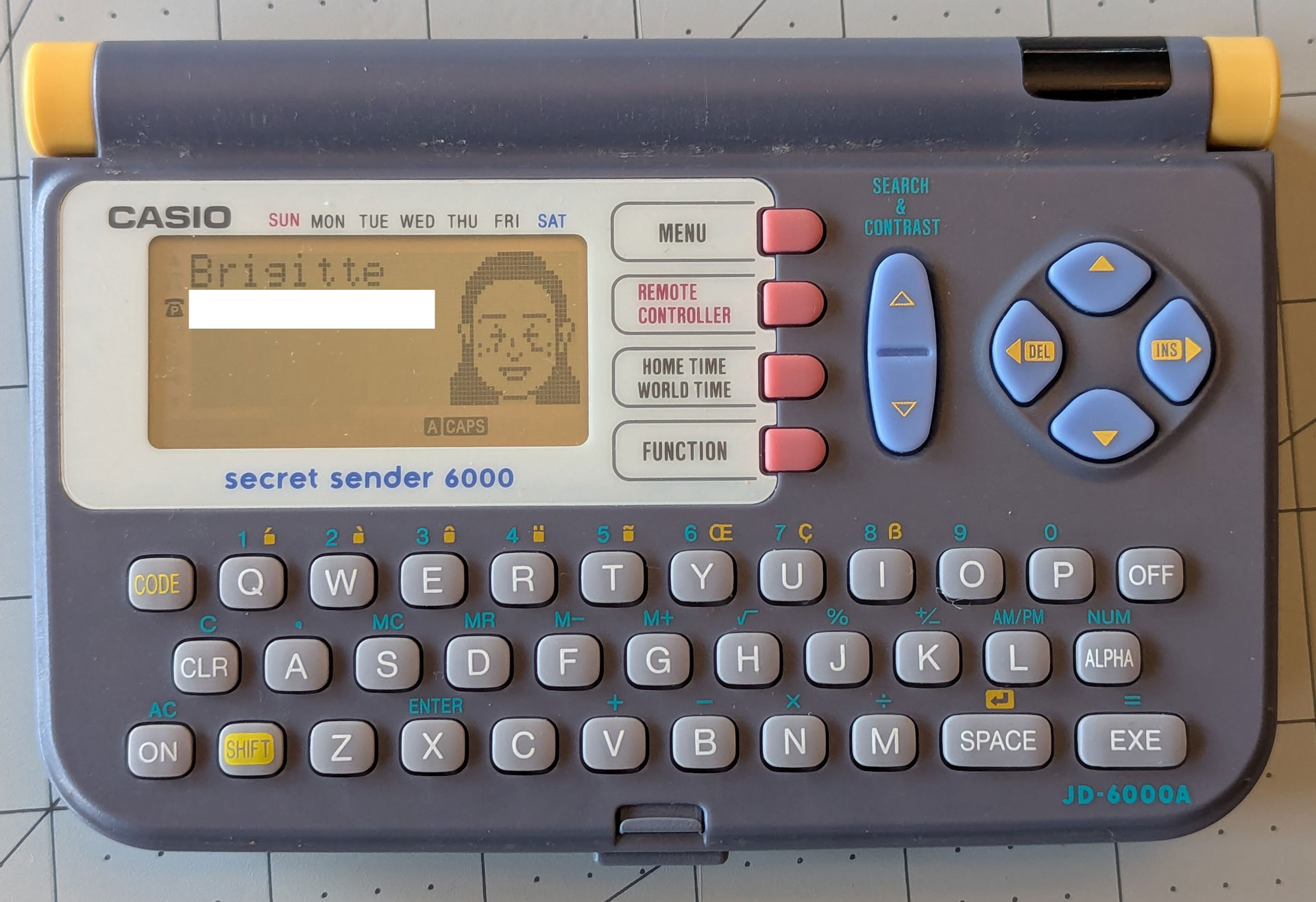
Another kid-friendly feature of the JD-6000 is what the commercial refers to as the "fun face maker" which gives the user the ability to add a profile image to their contacts. Despite the device's graphical limitations, the face maker is remarkably detailed. I think the art style does a good job of balancing being sufficiently detailed to capture the essence of a person with a cute cartoonish aesthetic, all while working within some serious constraints in terms of resolution. Reminiscent of character creation menus in video games, it allows the user to select a pre-made face to start, then gives options for hair, bangs, eyebrows, eyes, nose, mouth, outline (face shape), glasses, mustache, and beard. The options are extensive as well, with most of those categories featuring around 50 different choices giving the user (based on my napkin math) some 1.75 quintillion different combinations. The face maker is seriously fun and exceeded my expectations. The first time I explored it, I was grinning ear to ear for about 10 minutes clicking through all the options, and I could see kids getting very engrossed trying to make a portrait for each of their friends. These faces can be used in both the business and personal phone directories to put a face to the various names and numbers you store.
My wife and I each took a stab at drawing the other with the Fun Face Maker:
In addition to the kid-oriented features, in my opinion the JD-6000 is a well-implemented PDA. It has almost all the features you'd want and is well-organized and intuitive to use. The display is nice and it has a lot of character (and supports a lot of special characters for foreign languages). It doesn't have a backlight but few of its contemporaries did either. The only productivity features it's really missing that you might want from this style of PDA are a countdown timer, a stopwatch, to-do lists, and expense tracking. For a kid's toy, you'd also expect it to perhaps contain at least one game, but they likely had memory constraints that precluded the addition of one, and the input layout and style of LCD used would limit any potential inclusions to the realm of turn-based gameplay anyway. The included 10-digit calculator is serviceable if nothing special, and held back in terms of usability by a lack of dedicated buttons for numbers and mathematical operations.
The biggest issue with the JD-6000 is that it has a pitiful 4 kilobytes of memory meaning any serious user will quickly run out of space. That equates to a meager 70 contacts (if you store only contacts) or 120 scheduled events. Ironically, this is actually fewer contacts than the inferior JD-3500, because the 6000's additional address field and portrait make the contact entries a good deal larger. At least the JD-6000 can send mode data over infrared or via a connection port, and it seems to be partially or completely compatible with other Casio PDAs which is a nice feature. If little Jimmy reaches high school and outgrows the Secret Sender but wants to upgrade to a more professional model like the CSF-4950 he can transfer all his important data and reap the benefits of expanded memory, at least in theory. I haven't actually tested transferring data between these two units personally but the manuals for both devices indicate compatibility with a number of other models and they have similar communication settings.
Through my research, I have determined that several additional models of Secret Sender exist, in different colors and with different feature sets. Many models appear to be identical to the JD-6000, but with different colored shells, different features in lieu of the remote functionality, and in one case, sold under a different brand name. I will attempt to enumerate them here, but by no means is this an exhaustive list. There were dozens of different Casio "Magic Diary" and/or "Casio Cool" products on the market and information on them is sparsely available, much of which I have been able to glean solely through eBay listings or archived manuals.
For the "budget model", it appears there was a JD-3600 in a different color scheme, but with nearly identical features to the 3500.
The JD-5000 was a "magic diary" only, with the face maker and many of the other features of the JD-6000, but with no IR features, so no remote control or messaging abilities. The JD-5500 seems to have been a model with infrared messaging but no remote control, which featured a "triple play" game about which I haven't been able to find much information.
The 6500 and 6600 were "Pet Action" models that replaced the remote mode with a "Magic Beam" which seemingly used the IR module to enable the user to interact with a virtual pet dog. You can see this in action in this commercial which also promotes the JD-3500.
The Sega IR-7000 was a variation of the JD-6000 sold under the Sega brand in a hip translucent grey case, and the boring remote-control feature swapped out for some kind of battle game that you could play against your friends. It was also sold in a plainer opaque case with Casio branding as the JD-7000.
It's interesting to note the different approaches Casio took to marketing each of the variations of secret sender. The JD-6000, which seems to have been the best-selling model, was marketed as a "Secret Sender" and not aimed at one particular gender, while the "Pet Action" model was marketed towards girls as a "Magic Diary" (nomenclature that may prove off-putting to the male demographic). Meanwhile, Sega with their too-cool-for-school Sonic the Hedgehog credentials cornered the boys' market with their "battle" rebadge. Thus, with fairly superficial changes, Casio diversified the same Secret Sender hardware into three different products to satisfy each of the three genders: television, puppies, and battle. Perhaps in the future I'll acquire each of these models to verify their compatibility, though I suspect the messaging protocol is identical and they'll talk to each other without issue.

Image from Seinfeld Season 9 Episode 15, "The Wizard" (1998)
One final footnote in the story of the Casio Secret Senders is their appearance in Seinfeld season 9 episode 15, The Wizard (not to be confused with The Wiz). Specifically, the JD-6600 Pet Action model made a cameo as a malfunctioning knockoff PDA, which ends up losing Kramer the Del Boca Vista condo association presidency election. While this episode is neither the first appearance of a Casio product in Seinfeld—their ubiquitous digital watches can be seen adorning the wrists of extras and main cast members alike throughout all 9 seasons—nor the first appearance of a PDA—one plays a pivotal role in the season 5 episode The Marine Biologist, in which Elaine is unable to stop the alarm on her organizer and it is thrown from a moving limo—it is notable for two reasons: first is the remarkable clarity with which the specific PDAs are shown and second is the sheer number of them; in one shot, four JD-6600s are visible simultaneously. One can only speculate that the presence of a half-dozen Secret Senders on set led to the cast getting swept into at least some Secret-Sending antics off-camera, but the world may never know.
While the Secret Sender is obviously a reputable product from a respected manufacture and its depiction as a shoddy knockoff could be construed as offensive, I for one take the view that it's nice to see some solid screentime for one of the best child-oriented business tools of the last millennium. And not all the on-screen usage of the Secret Sender is counterfactual either; during the brief but impactful scene, one of the background characters remarks, "mine doesn't have a seven." This is technically true, as the JD-6600 like all the Secret Senders has no number keys at all and simply re-uses the top row of letter keys for numerical input.
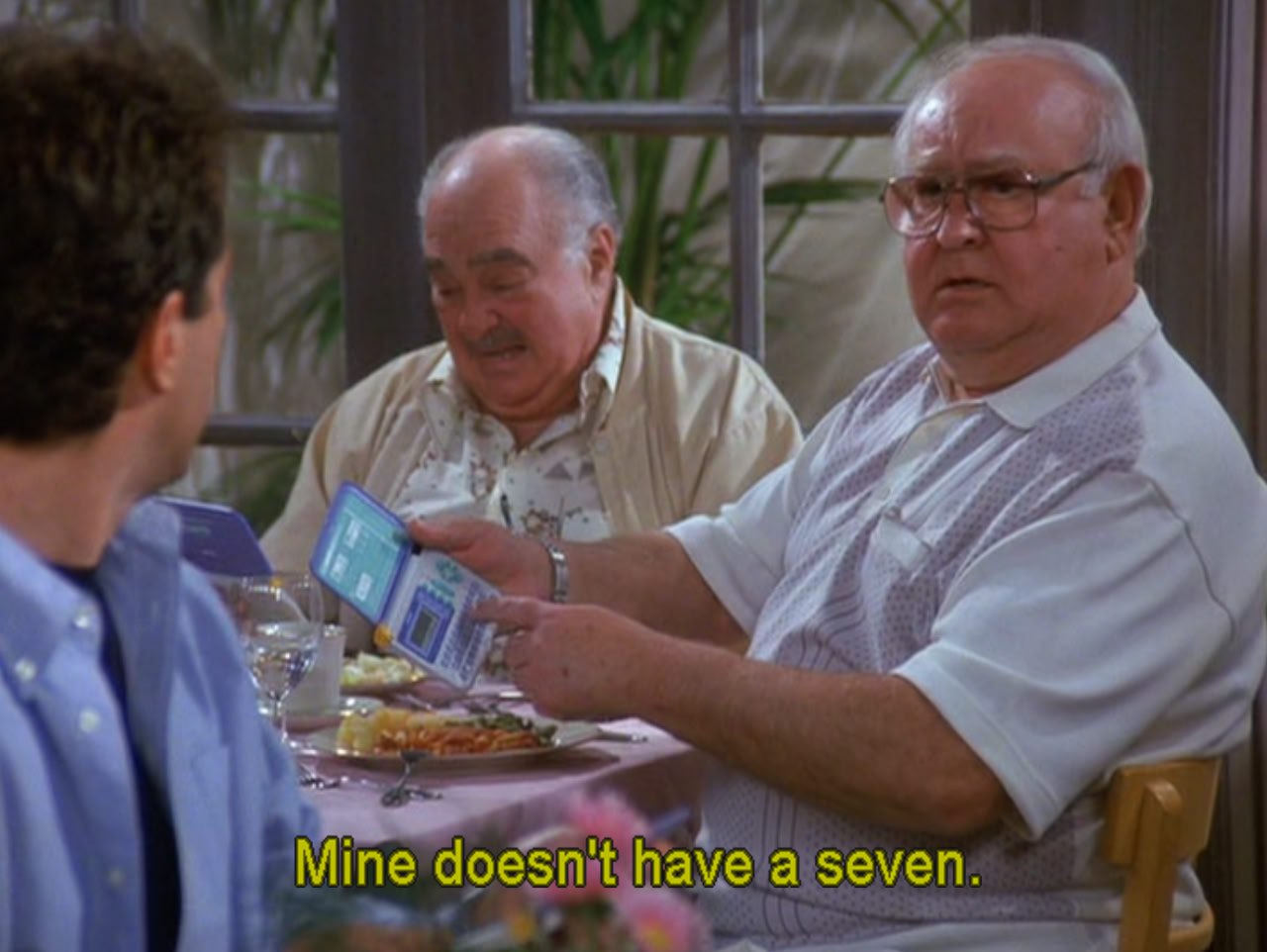
Image from Seinfeld Season 9 Episode 15, "The Wizard" (1998)